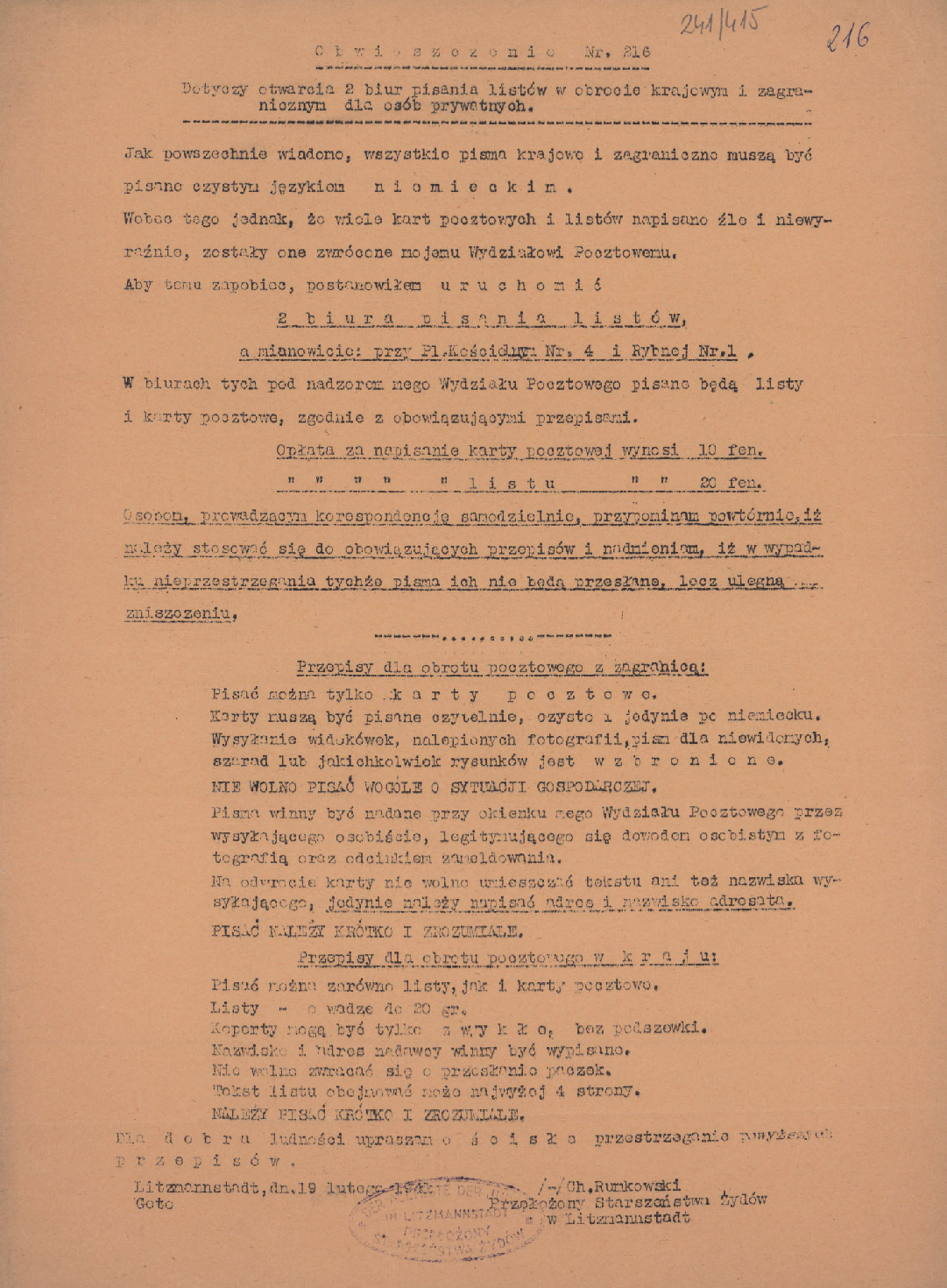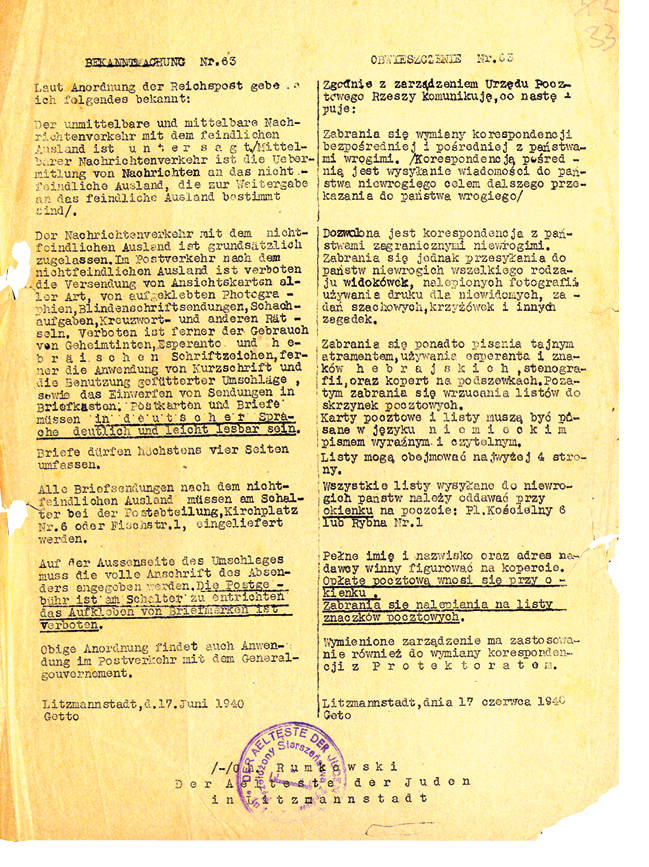
Announcement No. 63 regulating the rules of correspondence
(Archiwum Państwowe w Łodzi)
Announcement No. 63
By
order of the Reich Post Office, I inform you as follows:
Direct
and indirect correspondence with hostile foreign countries is
prohibited (indirect correspondence is the transmission to
non-hostile foreign countries of information intended for their
onward transmission to hostile foreign countries).
Correspondence
with non-hostile foreign countries is generally permitted. In mail
traffic to foreign hostile countries, it is forbidden to send
postcards of any kind, pasted photographs, mail written in writing
for the blind, chess tasks, crossword puzzles and any other puzzles.
In addition, the use of sympathetic ink, Esperanto and the Hebrew
alphabet, shorthand and padded envelopes, and the dropping of mail
into post office boxes are prohibited.
Postcards
and letters must be written in German, in clear and legible
handwriting. Letters may be a maximum of four pages in length.
All
letters addressed to non-native foreign countries must be posted at
the Postal Department window at either No. 6 Church Square or 1 Rybna
Street.
The
full address of the sender must be indicated on the top of the
envelope. Postage must be paid at the window; sticking stamps is
prohibited. The above regulation also applies to postal traffic with
the General Government.
Litzmannstadt-Getto,
June 17, 1940.
(-) Ch. Rumkowski
The
Eldest of the Jews
In
Litzmannstadt