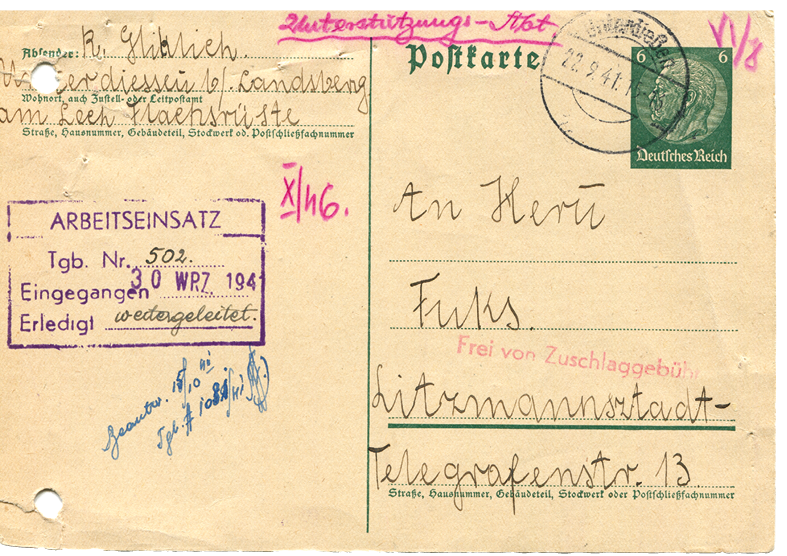
From the end of 1940, Jewish workers were used to build the Posen-Frankfurt motorway on the Oder River. About 14 Reichsautobahnlager (RAB) camps were established along the motorway. The supply of labor from the Łódź ghetto was provided by the Jewish Bureau of Labor. The incentive was certainly the possibility of sending 12 Mk a week to the family in the ghetto. Over time, and with increasing awareness of the hard work and difficult living conditions in the camps, the number of volunteers dropped and RAB was ordered to persons sentenced by the Court in the ghetto. It is estimated that about 10,000 Jews worked on the construction of motorways.
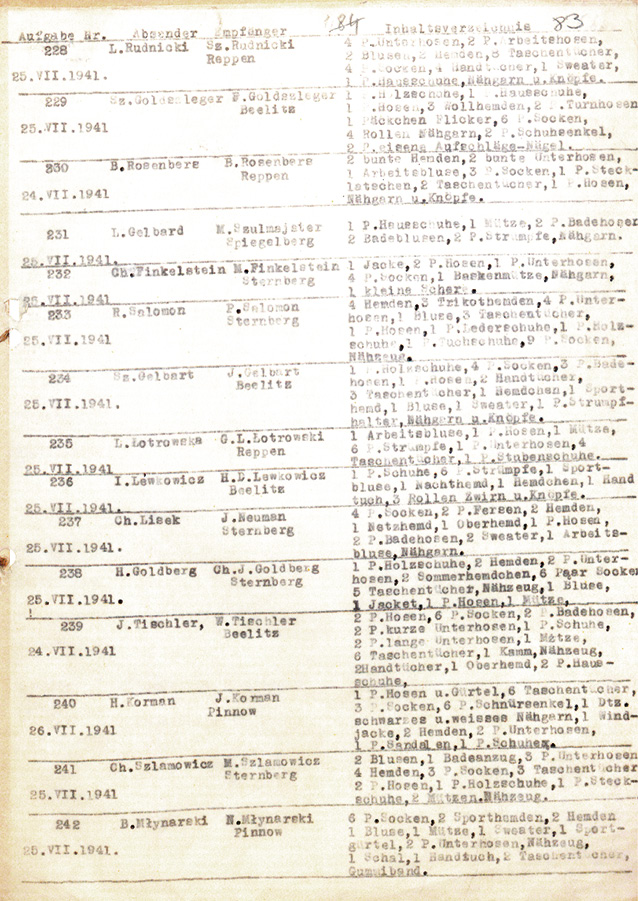
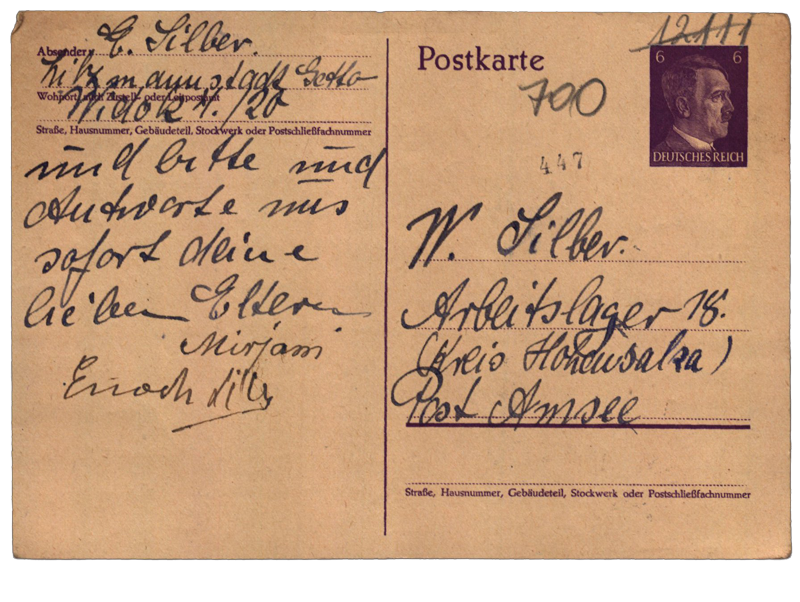
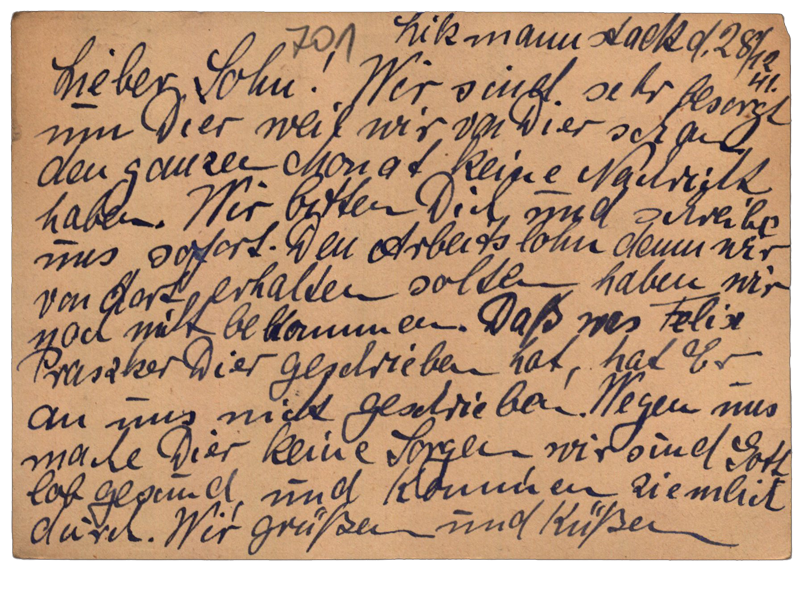
Correspondence between the camps and the ghetto was permitted under the general rules in force in the closed district. It was also possible to send parcels that did not contain food. Only in 1941 2917 such parcels were sent to RAB camps. Many postcards from the camps were addressed to the head of the Bureau of Labor, asking for the overdue wages to be paid to the family.
Chronicles of the Łódź Ghetto, November 4 1942.
”Large amounts of mail have also been coming in from local ghetto residents, who are now in labor camps outside the ghetto. Principally, the letters contain requests for worm clothing. This is the only kind of package sent outside the ghetto. These clothing packages, amounting to 25 every week, are expedited by the post office by the basis of certificates from Bureau of Labor. The mailing of food is not permitted.”
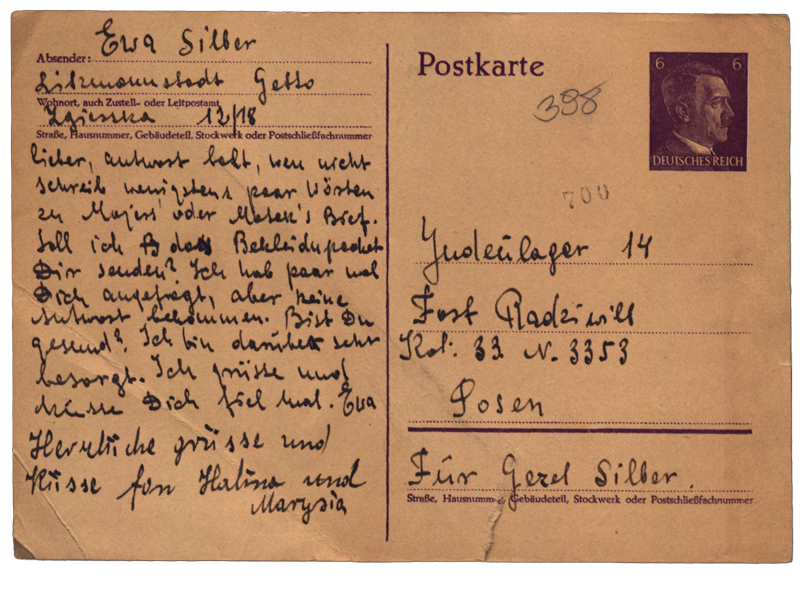
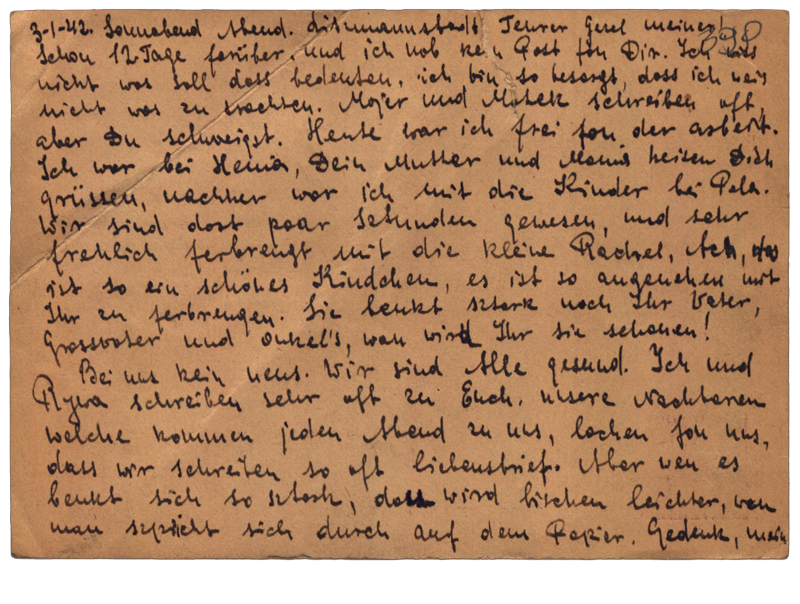
The ability to simultaneously research the collection of the Spungen Foundation and the holdings of the State Archives in Lodz made it possible to collect postcards sent by Ewa Silber and her daughters to her husband Gecel, who was in a labor camp.
Ewa (b. 1902) and Gecel (b. 1899) Silber with their daughters Halina (b. 1926) and Marysia (b. 1930) lived at 11 St. Reymonta Street in Brześć Kujawski until the outbreak of war.
In June 1941, a group of young Jews from Brześć were sent to a camp in Fort Radziwiłł near Poznań. Among these individuals was also Gezel Silber. In 1943 he was probably taken to Aushwitz-Birkenau, where he died.
Ewa with her daughters and Gecel's parents, Enoch (born 1872) and Miriam (1878), were deported to the Lodz ghetto on September 28, 1941. Ewa and her daughters lived at 12 Zgierska Street and later at 10/23 Stary Rynek Street, while her in-laws lived at 4/20 Widok Street and 38/40 Zawiszy Czarnego Street. Enoch Silber died on January 31, 1943.
Ewa with her mother-in-law and daughters-in-law were deported to Auschwitz-Birkenau in August 1944. Only Halina survived the war. She was sent to a labor camp in Christianstadt, then to Bergsen-Belsen, where she lived to see liberation. She was sent to Sweden to recovery. After marrying as Halina Hershfang, she settled in Ramat Gan, Israel.