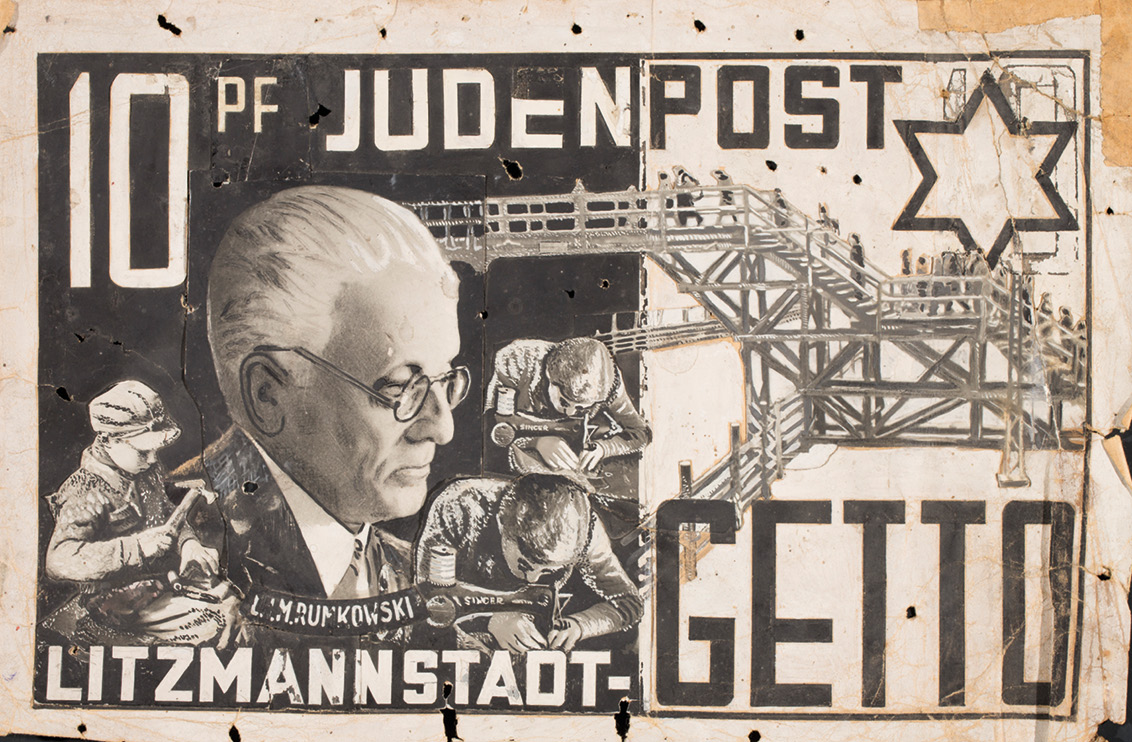
Design of the ghetto stamp
(Żydowski Instytut Historyczny)
Rumkowski
returned to the idea of issuing a stamp probably as late as
1943.Perhaps the idea that the name Judenpost should appear on the
stamp was taken from one of the earlier designs. The use of Yiddish,
which had been officially banned in the ghetto since October 1942,
was also abandoned.
Light
is shed on the behind-the-scenes preparation of the stamps by the
postwar account of Sara Fajtlowicz (Gliksman during the war), who
worked in the Ghetto Statistics Department.
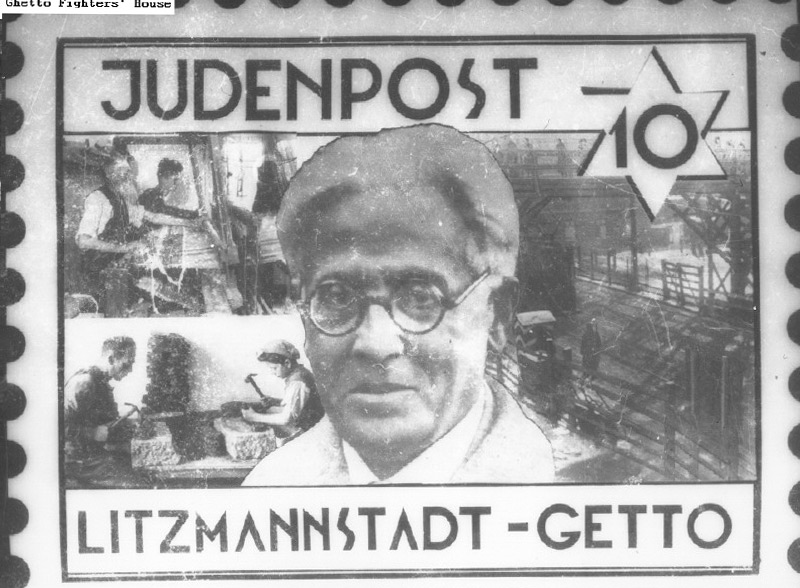
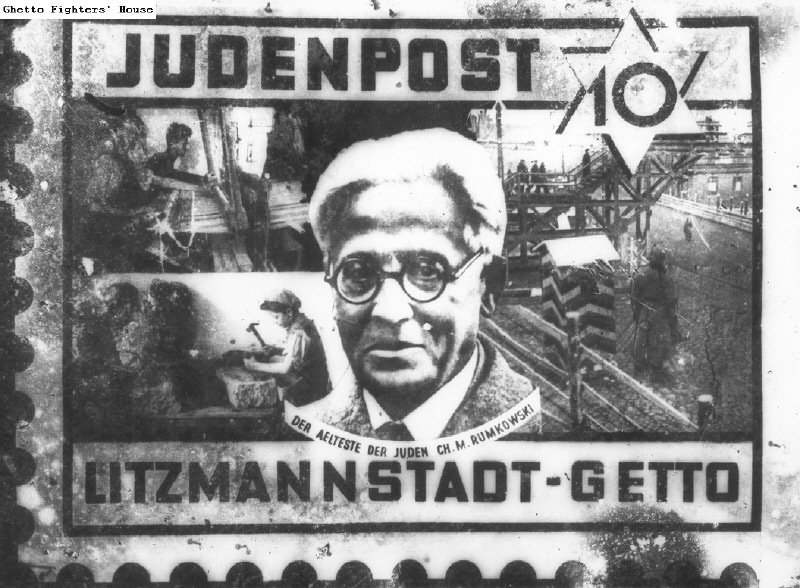
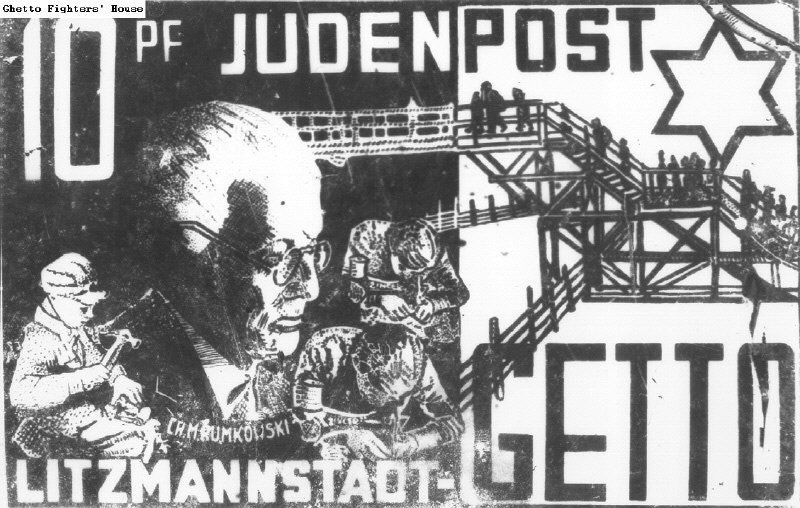
“After making these albums for Rumkowski, we proceeded, at his request, to make postage stamps. Of course, on such a stamp, according to Rumkowski's demands, there was to be his portrait, a bridge, a few [scenes] from the resort, the inscription “Judenpost Litzmannstadt Getto” and the Star of David. In view of these subjects, the stamp could not be pretty, but an order is an order. The technical side was handled by [Henryk] Ross. Of course, there was a competition and there were several editions of these stamps. At first the stamps were without perforations, a lot of rehearsals were done, we were busy with this all year.
Being at an international philatelic exhibition in Tel Aviv recently, I found by chance in a collection from the ghetto the stamps that I designed and that Ross designed and made. It was very shocking to me that I was alive after all, and my works were listed without a signature.”
Yad Vashem, O3/3889, Testimony of Sara Fajtlowicz
Chronicle of the Łódź Ghetto, February 29, 1944.
”The Chairman is planning to issue a ten-pfennig stamp for the internal mail service in the ghetto. Two designs have already been submitted; presumably, they will be used one after the other. The Chairman, however, intends to put only a very small number of stamps (barely a thousand) into circulation, and to print only a few thousand altogether. He has received permission from the German authorities to issue there stamps.”
The release of the first series of stamps is also mentioned in Chronicle, although the description could also be applied to several other projects. The release coincided with Rumkowski’s birthday on March 27.
Design of the ghetto stamp
(Żydowski Instytut Historyczny)
Design of the ghetto stamp
(Żydowski Instytut Historyczny)
Design of the ghetto stamp
(Żydowski Instytut Historyczny)
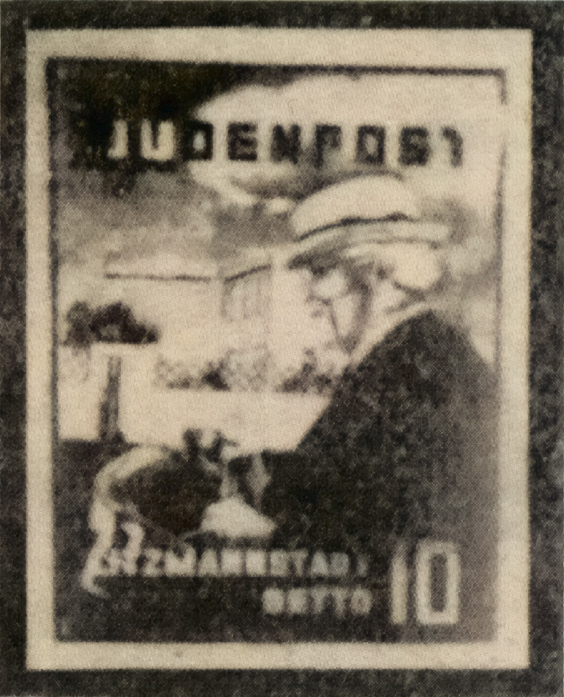
Design of the ghetto stamp
(Przegląd Filatelistyczny, 1949, nr 7)
Another
entry appeared on March 9, 1944, the holiday of Purim, the day on
which Rumkowski traditionally celebrated his birthday.
Chronicle of the Łódź Ghetto, March 9, 1944.
” Today, on his birthday (at the same time the holiday of Purim), the Chairman received numerous messages of good wishes. This time he was not congratulated personally, because on the one hand the day was busy, and on the other hand the Chairman was not feeling very well and remained in bed. Together with Mr. Rozensztajn (printing house), Mr. Gumener (post office) and Mr. Dawidowicz (Philatelic Department), the Chairman held a meeting concerning the first ghetto postage stamp. The first series of five- and ten-phennig stamps is now ready, albeit in a limited edition. The stamps feature the portrait of the Chairman and the symbols of the ghetto (the footbridge at Kirchplatz and working youth). The Chairman has ordered that telegrams with birthday wishes sent to him be postmarked with the new stamps and special labels.”
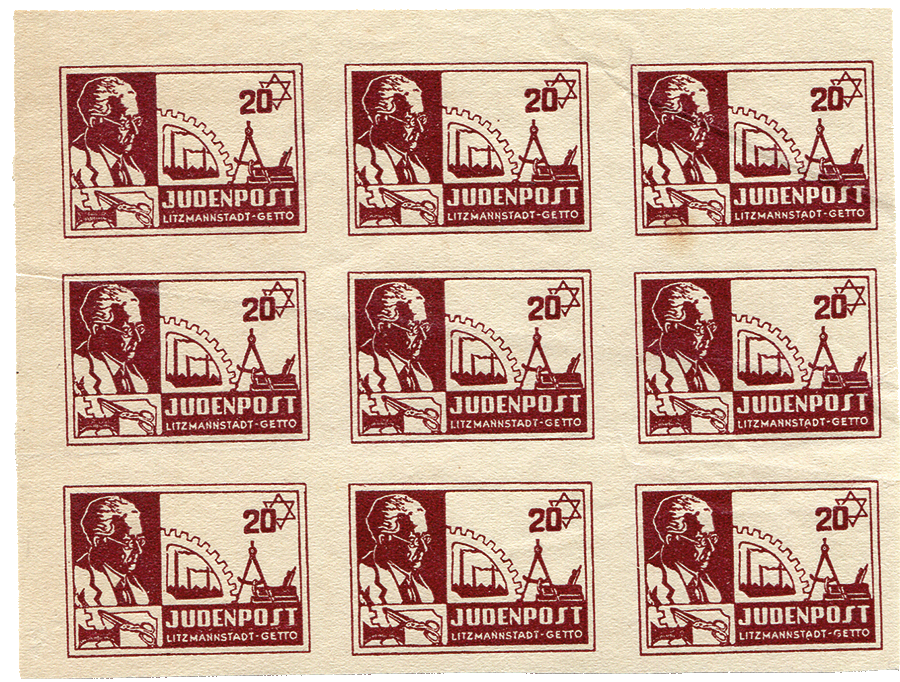
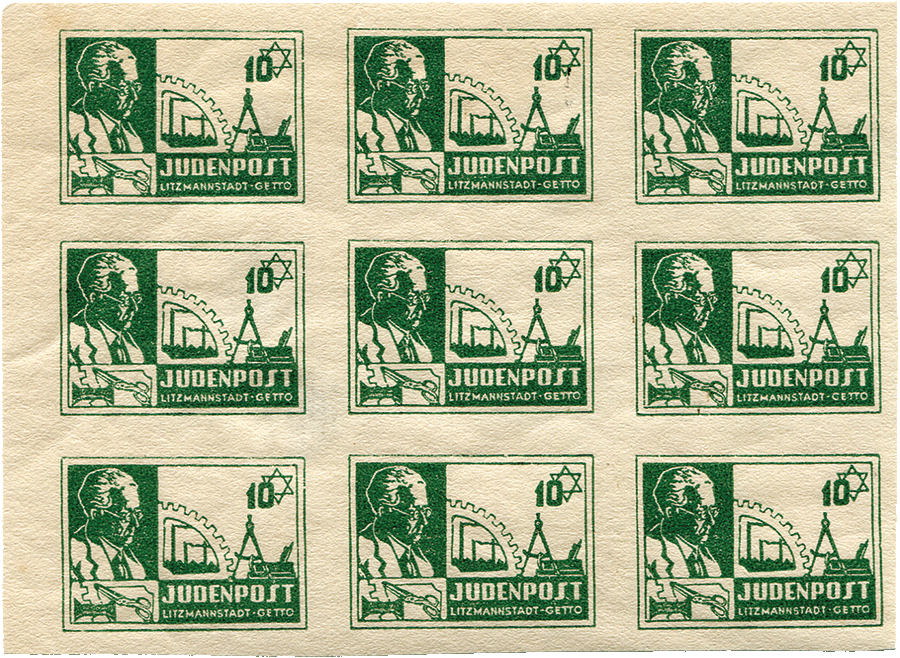
Two
designs were most likely printed:
-
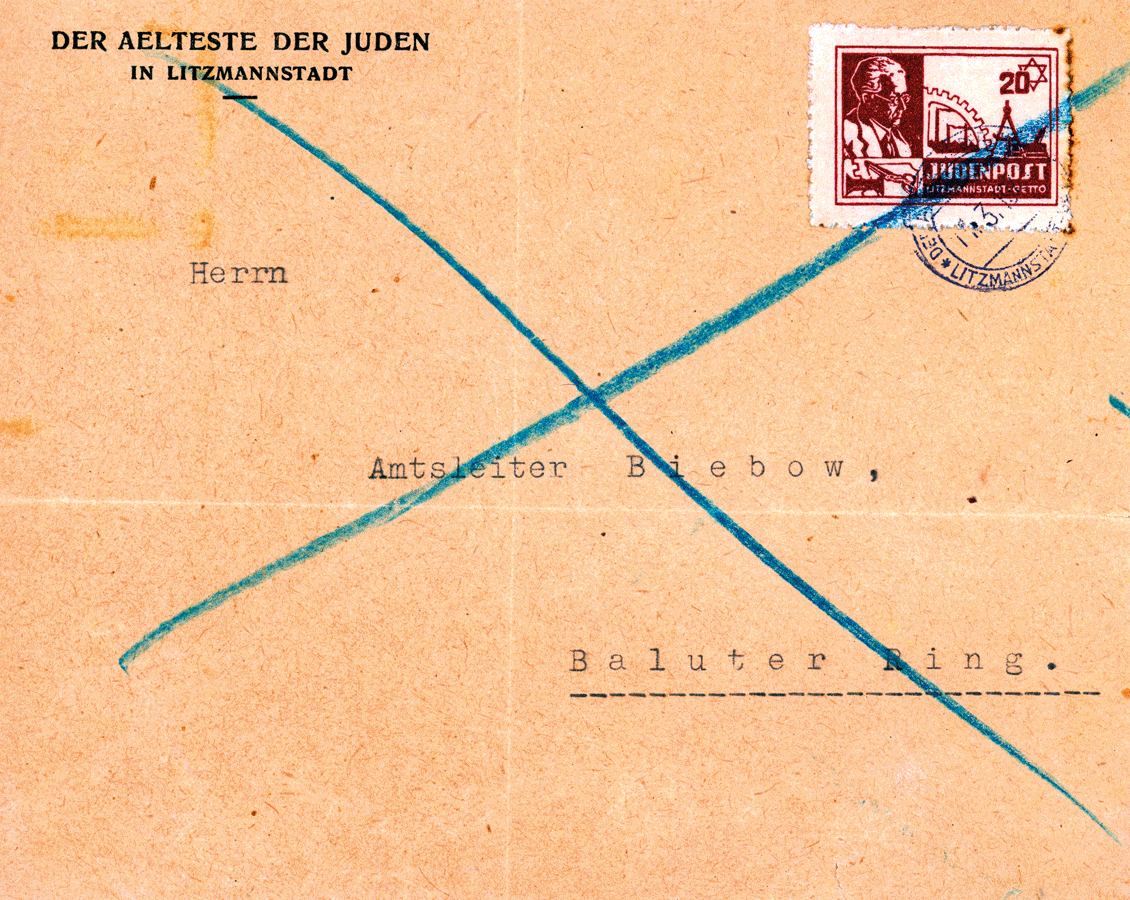
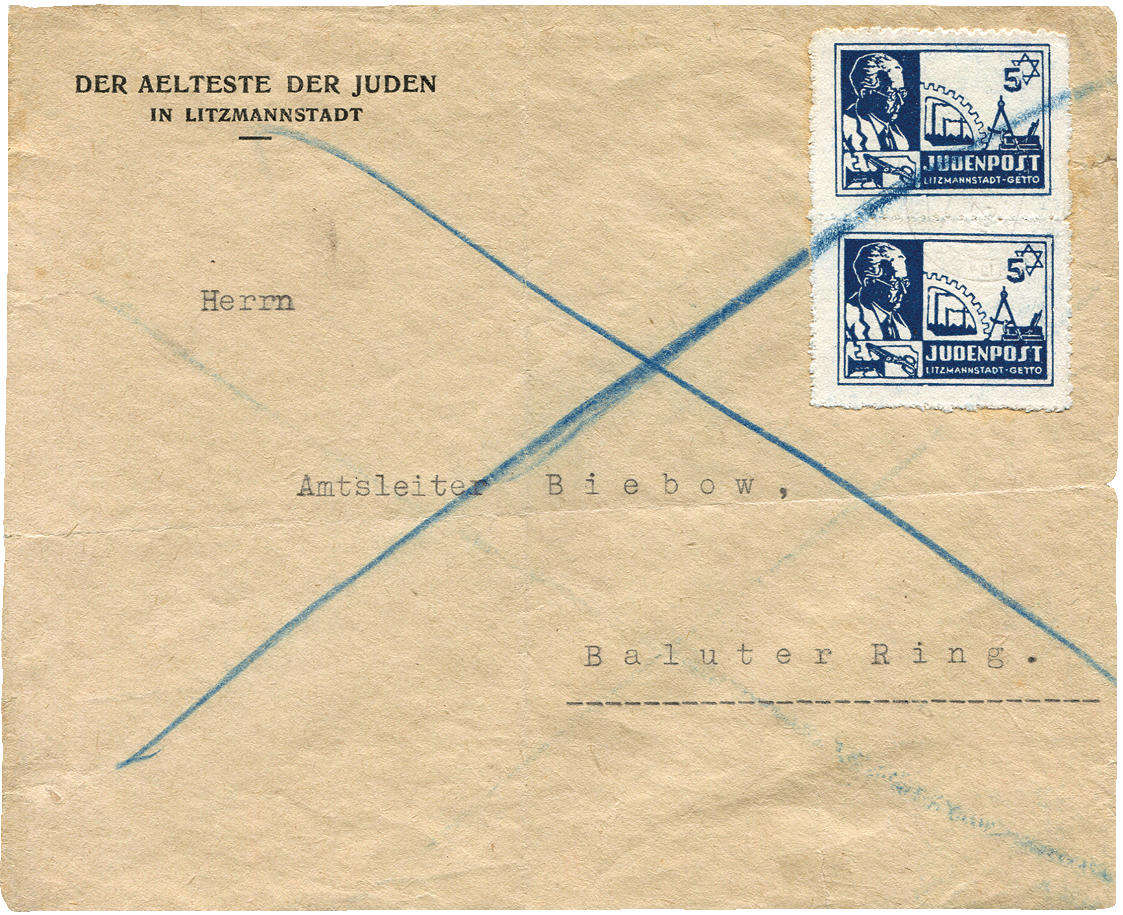
attributed to Pinkus Szwarc, a design of a completely different
style, with a double frame, Rumkowski's profile and a symbolic
depiction of elements that were to characterize the ghetto as a place
of labor: scissors, spool, cogwheel, hebel, barber and, it is worth
noting, chimneys, characteristic of Lodz. The stamp had denominations
of 5, 10 and 20 fenigs.
-
one attributed to Henryk Ross, a stamp with denominations of 5 and 10
fenigs (the digits placed in a star), a centrally placed face of
Rumkowski, a bridge over Zgierska Street and workers
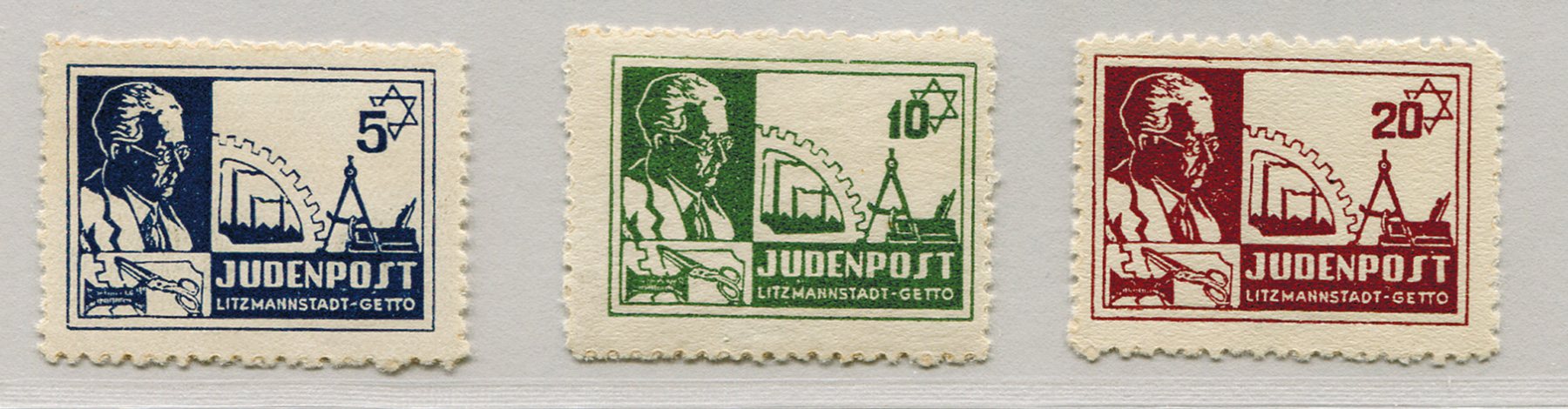
Materials from the collection of the Spungen Family Foundation
(Spungen Family Foundation)
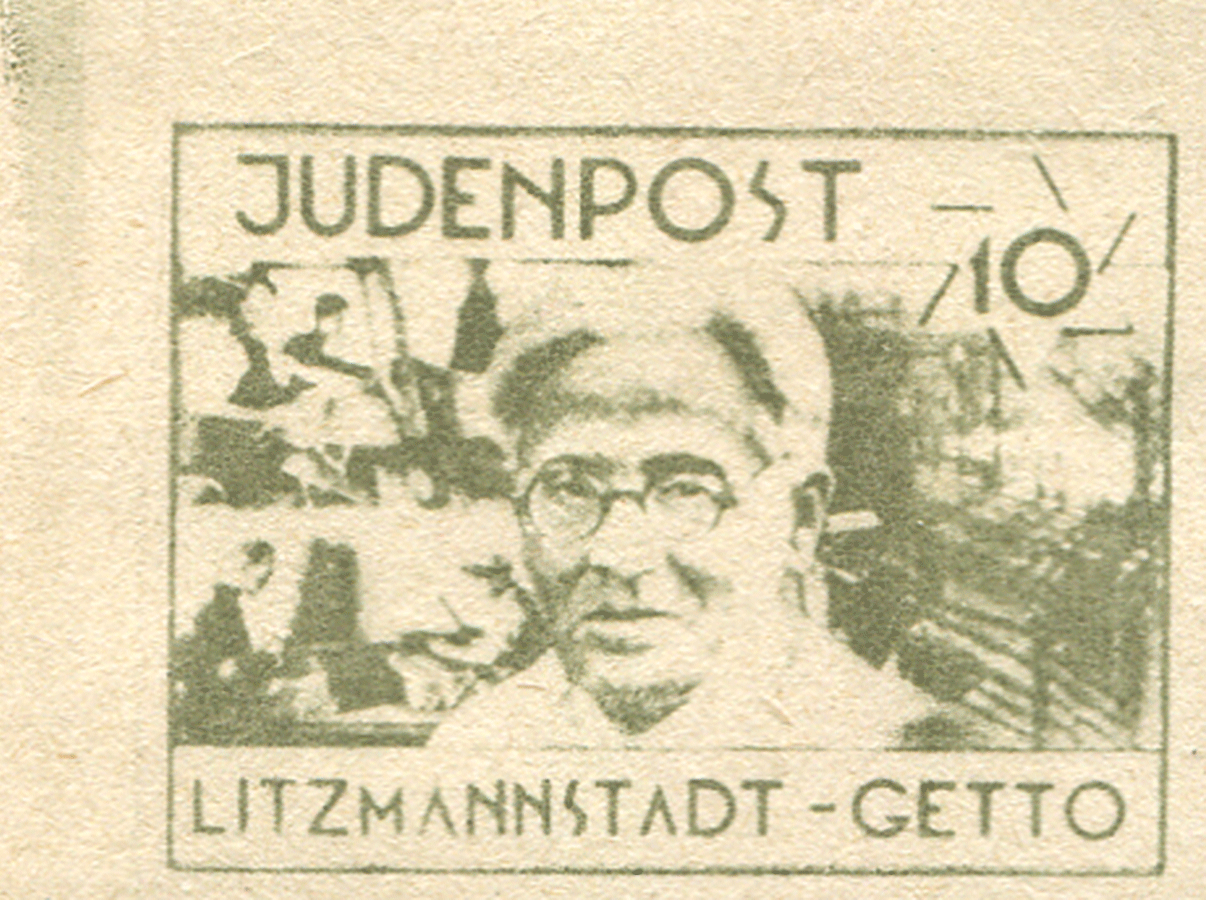
Materials from the collection of the Spungen Family Foundation
(Spungen Family Foundation)
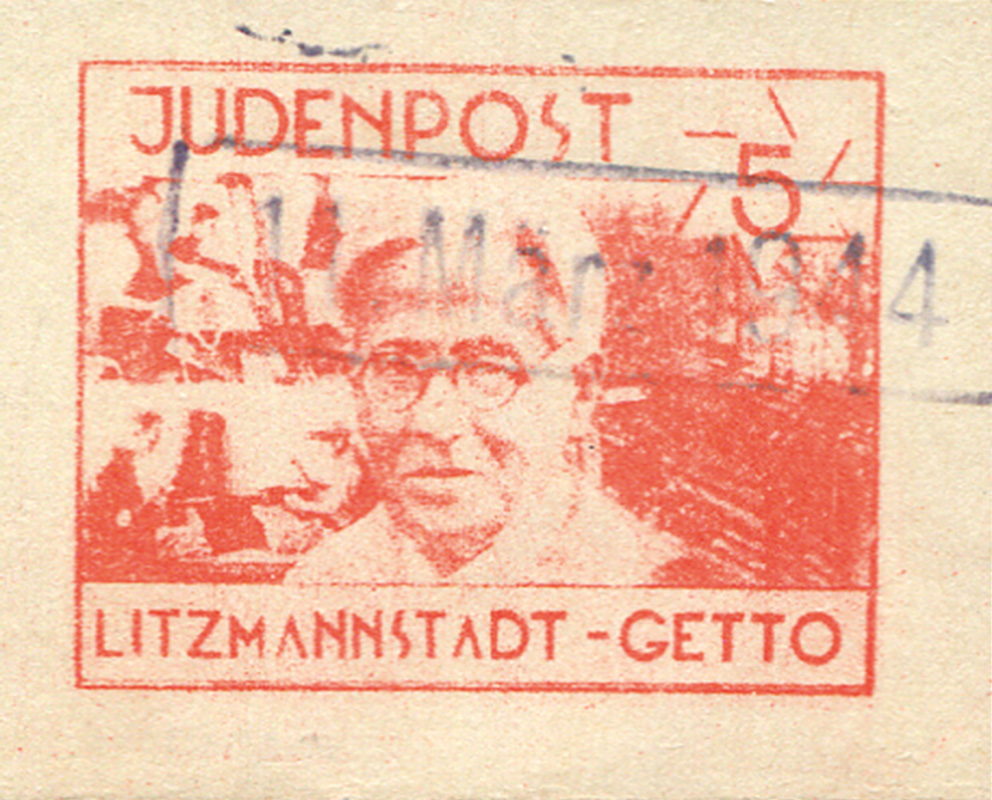
Materials from the collection of the Spungen Family Foundation
(Spungen Family Foundation)
Materials from the collection of the Spungen Family Foundation
(Spungen Family Foundation)
Materials from the collection of the Spungen Family Foundation
(Spungen Family Foundation)
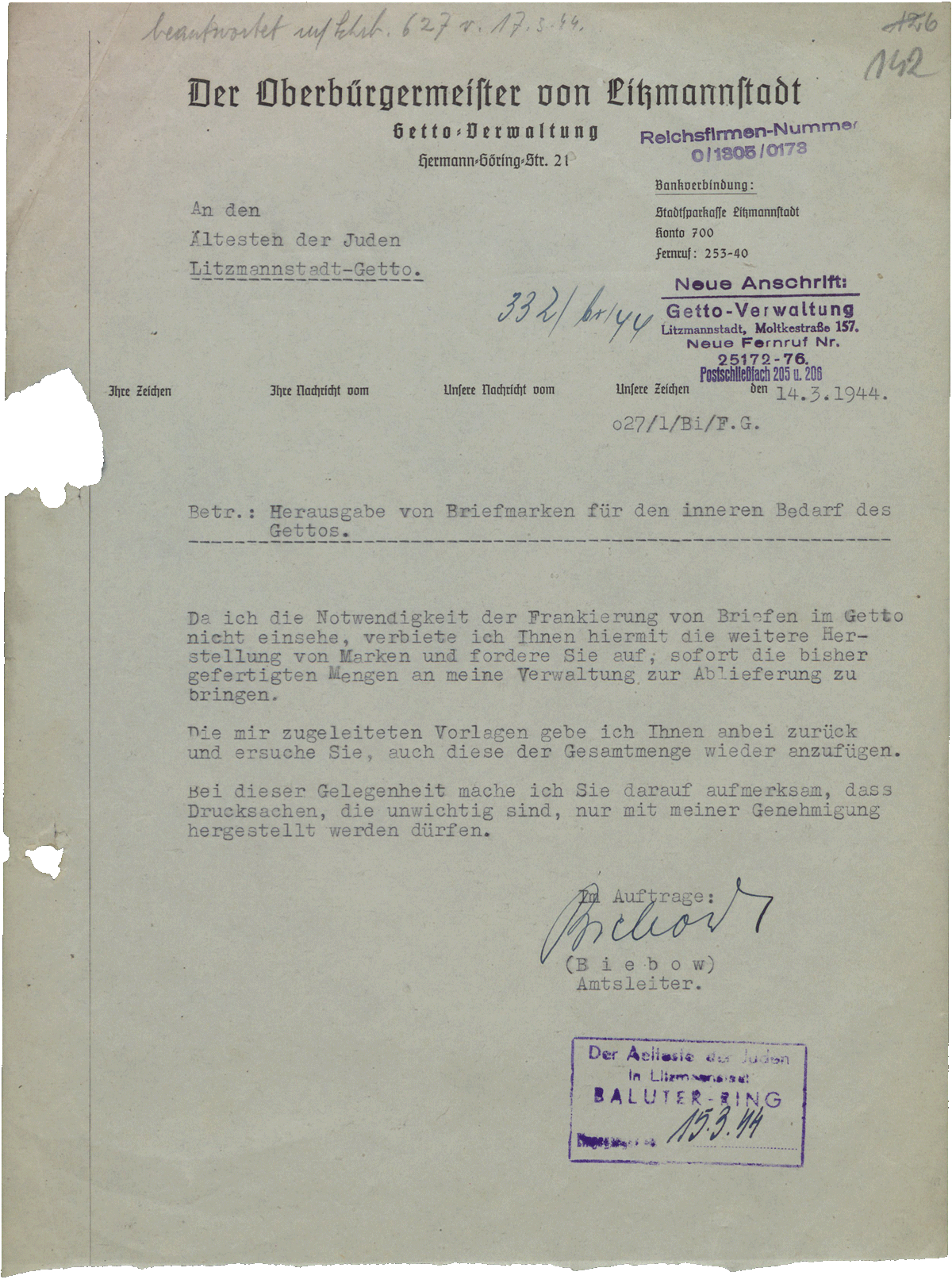
The
stamps could only be in circulation for a few days. Hans Biebow sent
a letter to the Superior of Jewish Elders forbidding their use and
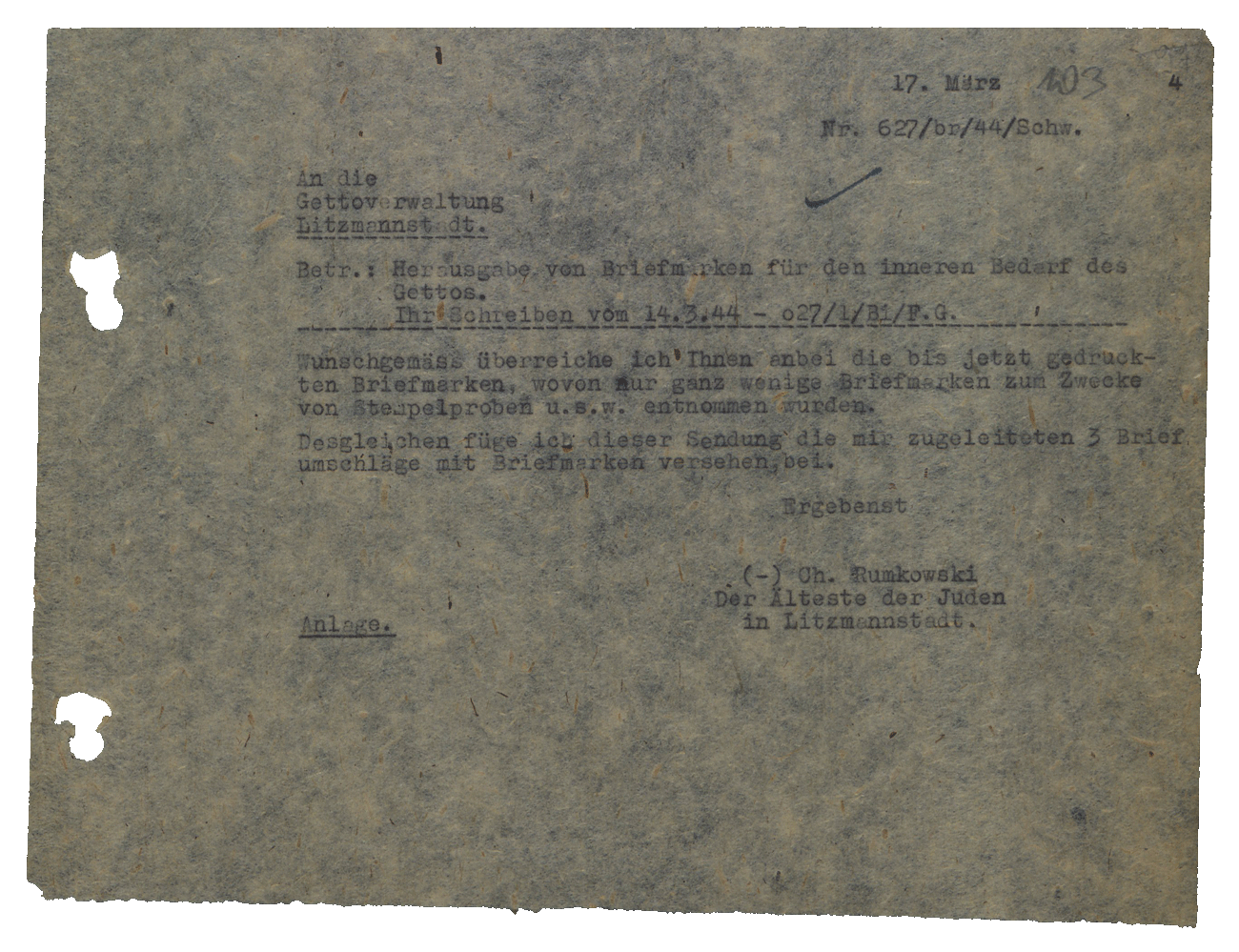
sending him back the entire print run. As can be seen from the
response - Rumkowski complied with the demand, adding the stamped
envelopes. All the unique philatelic material ended up in Biebow's
hands.
There
are opinions in the philatelic literature that both the issuance and
confiscation of the mintage were deliberate actions by Biebov, who
thus acquired unique philatelic material.
(Archiwum Państwowe w Łodzi)
Letter from Head of Gettoverwaltung Hans Bibow to Chaim Rumkowski, The Eldest of the Jews In Litzmannstadt
To
The Eldest of the Jews
In
Litzmannstadt
14.3.1944
o23/1/Bi/F.G.
Re: Issuing postage stamps for
internal use in the ghetto
As
I see no need for franking letters in the ghetto, I hereby prohibit
you from continuing to produce stamps and request that you
immediately deliver the quantities produced to date to my
administration.
I
enclose the designs sent to me and request that you add them to the
entire collection.
I
would like to take this opportunity to point out that printed matter,
even if not essential, may only be produced with my consent.
On behalf of
Hans Biebow
Head
of Gettoverwaltung
(Archiwum Państwowe w Łodzi)
Chaim Rumkowski's letter to the German Ghetto Administration
17th March
To
Ghetto
administration
Litzmannstadt
Nr
627/br/44/Schw.
Regarding
the issue of postage stamps for internal use in the ghetto.
With
reference to your letter of 14 March 1944 – o27/1/Bi/F.G.
As
requested, I am enclosing the postage stamps printed to date, only a
few of which have been withdrawn due to problems with the overprint,
etc.
I
am also enclosing 3 envelopes with stamps that were given to me.
Yours sincerely
Ch.
Rumkowski
The
Eldest of the Jews
In
Litzmannstadt
Materials from the collection of the Spungen Family Foundation
(Spungen Family Foundation)
Materials from the collection of the Spungen Family Foundation
(Spungen Family Foundation)