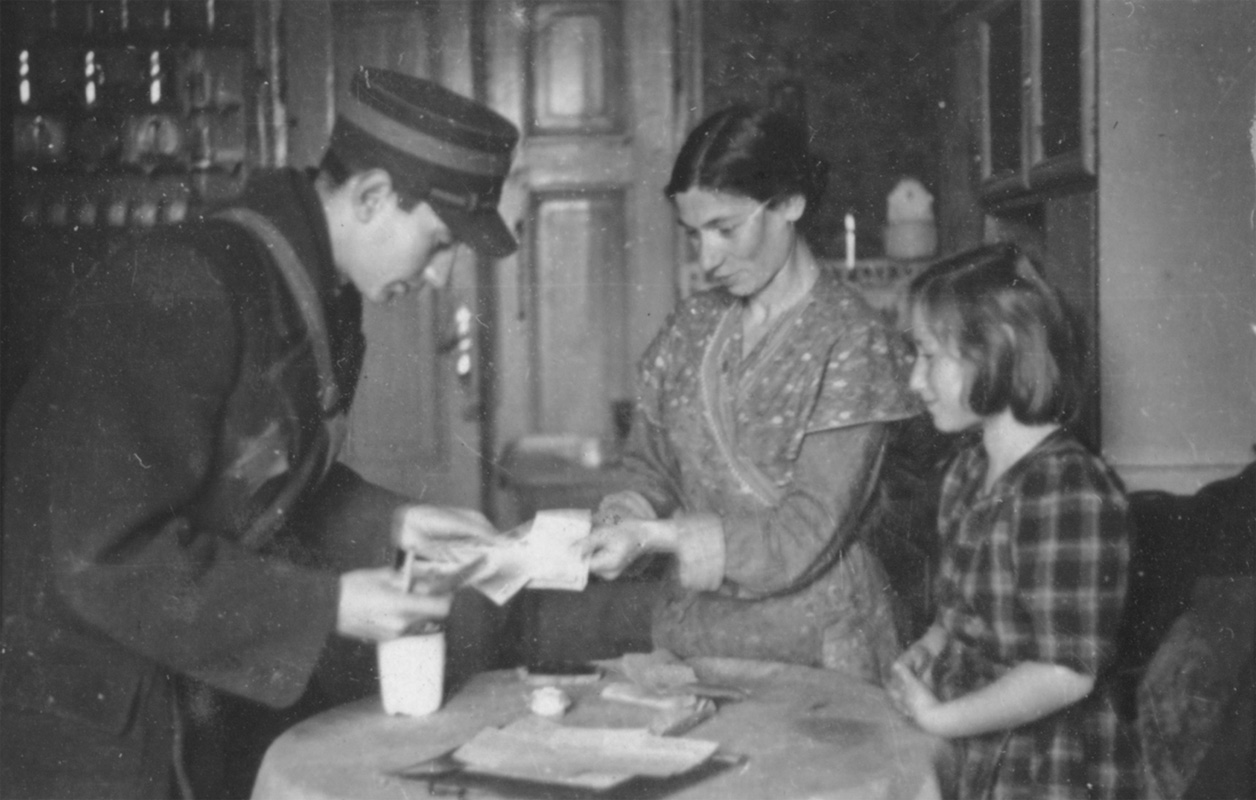
Postman delivering unemployment benefits
(Archiwum Państwowe w Łodzi)
Postmen were responsible for delivering private and official correspondence. The latter included both correspondence between departments and official mail to private individuals. It consisted mainly of coupons, benefits, notifications from the Bureau of Labor or laundry, decisions on granting leave, court letters and money orders.
One of the first important tasks was delivery of unemployment benefits. The social welfare reform carried out by Rumkowski in September 1940 stipulated that every unemployed person, regardless of their pre-war status, would receive a benefit. There was also to be money for children and elderly people. These benefits were meant to save thousands of people who, after several months in the ghetto, had no more means of subsistence left. Rumkowski borrowed 2 million marks from the German authorities, which he then repaid with goods produced in the ghetto. At that time, almost 80% of the ghetto inhabitants were entitled to the benefits.
Many people received money sent in the name of Rumkowski, which was deducted from the wages of workers employed outside the ghetto.
On Rosh Hashanah 1941, all children in the ghetto received gifts with sweets along with wishes: “Good holiday, dear children, from your Mordechai Chaim Rumkowski”. 30,000 such bags were distributed, 13,000 of which were delivered by postmen to children in parcels addressed to their names. Children from 2 to 7 years of age additionally received food vouchers for cooked dinners, also sent by post.
The postmen were also responsible for delivering deportation orders, called „wedding cards” in the ghetto parlance. During the first deportation operation in January-May 1942, such orders were delivered to almost 50,000 people.
Postman delivering unemployment benefits
(Archiwum Państwowe w Łodzi)
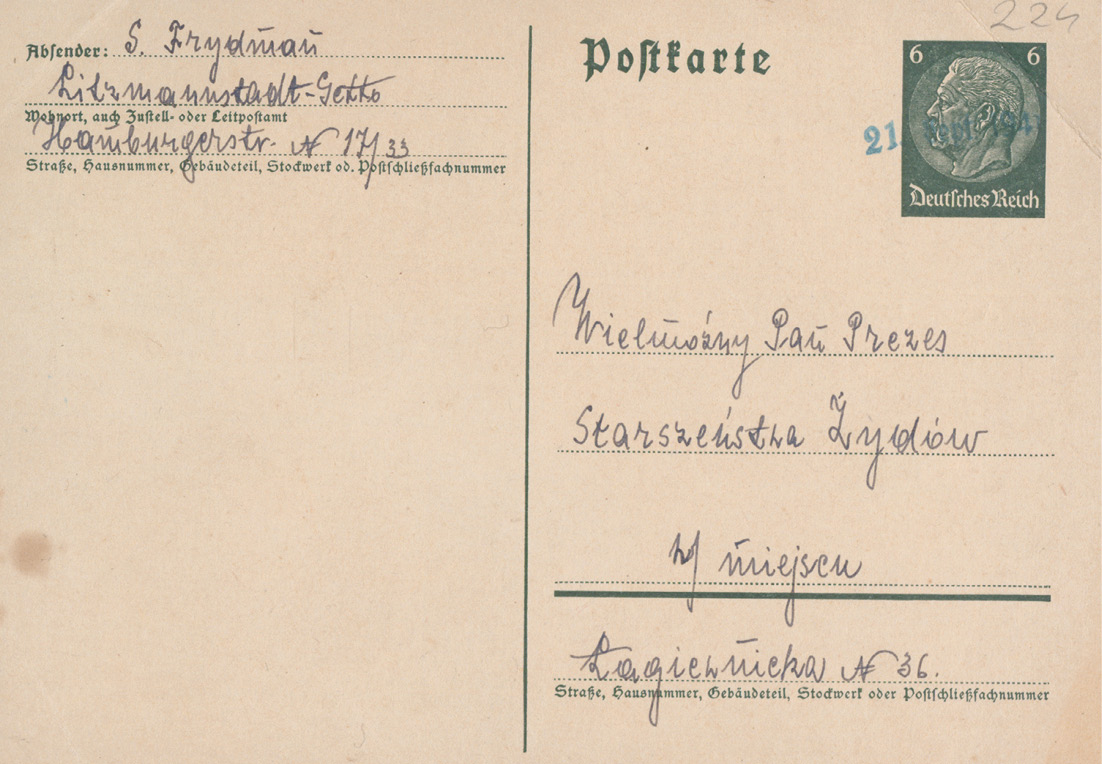
Postcard to Rumkowski thanking him for sweets, front side
(Archiwum Państwowe w Łodzi)
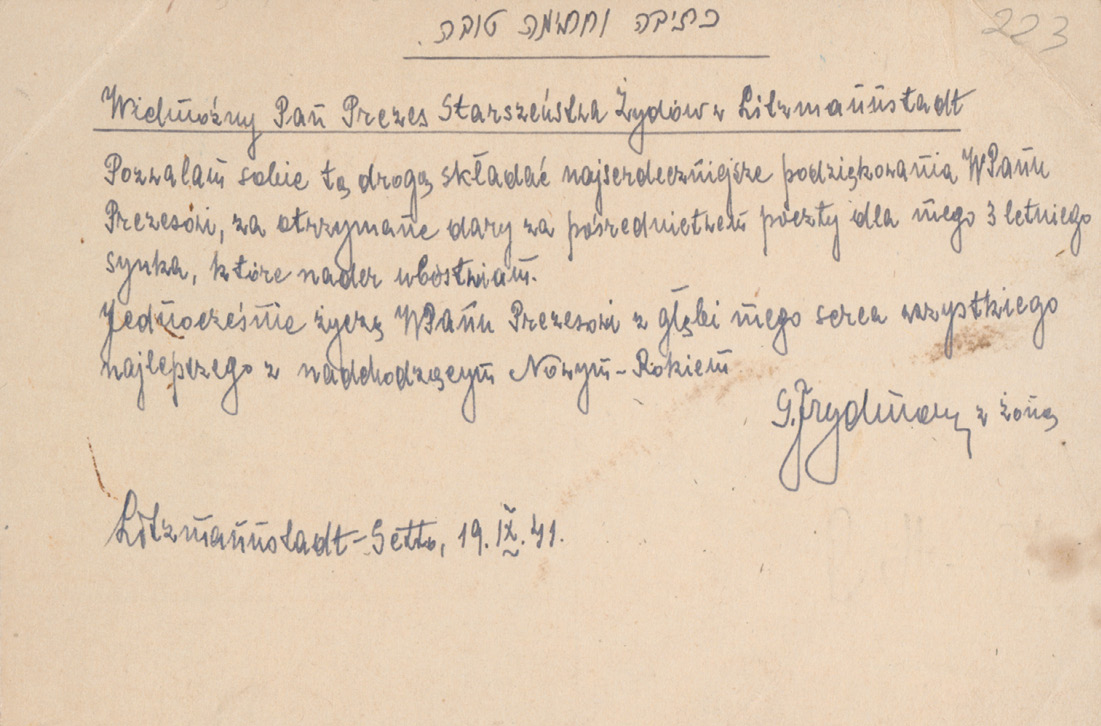
Postcard to Rumkowski thanking him for sweets, back side
(Archiwum Państwowe w Łodzi)
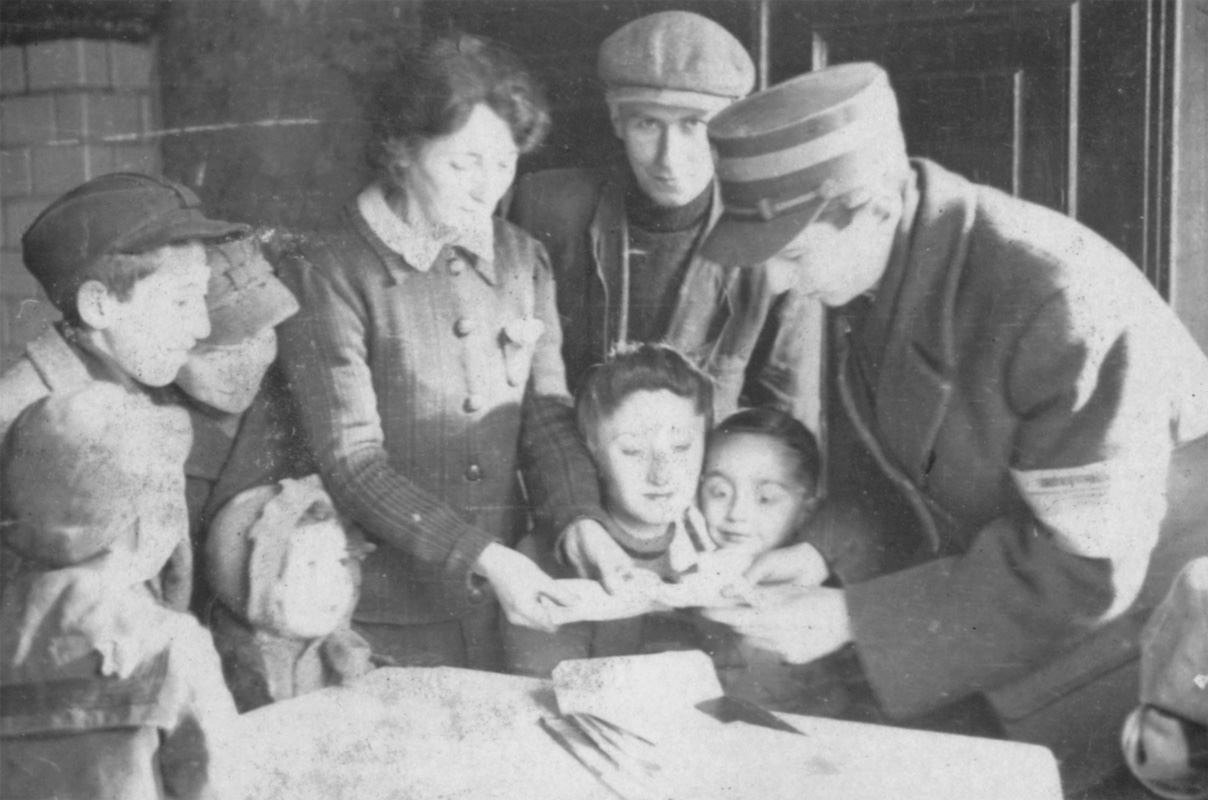
Postman delivering unemployment benefits
(Archiwum Państwowe w Łodzi)
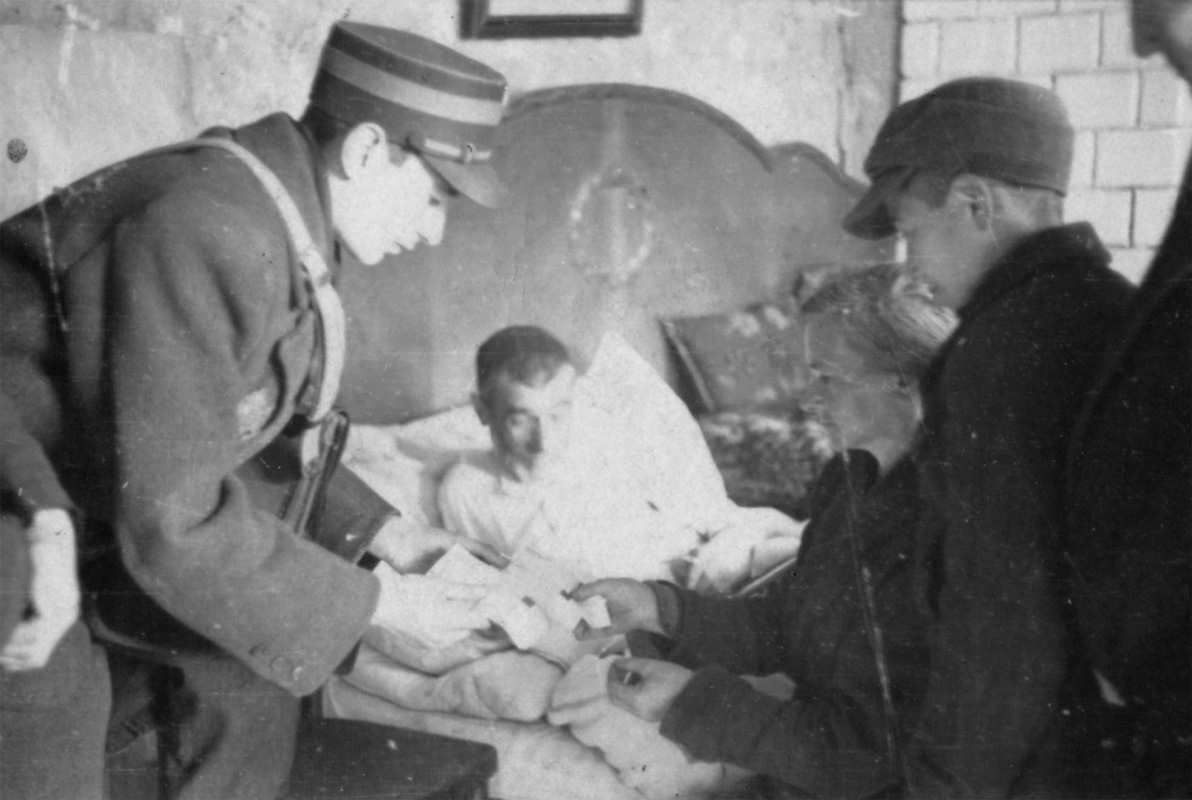
Postman delivering unemployment benefits
(Archiwum Państwowe w Łodzi)
”Here they have made themselves a messiah, put a green band around his cap, and put a bag on his shoulders. People spend a lifetime waiting for their messiah, wondering why he’s late and whether he’ll give them ten marks a head for those older then fourteen and ten marks a head for those younger.”
J. Zelkowicz, "The Messaiah Will be late"
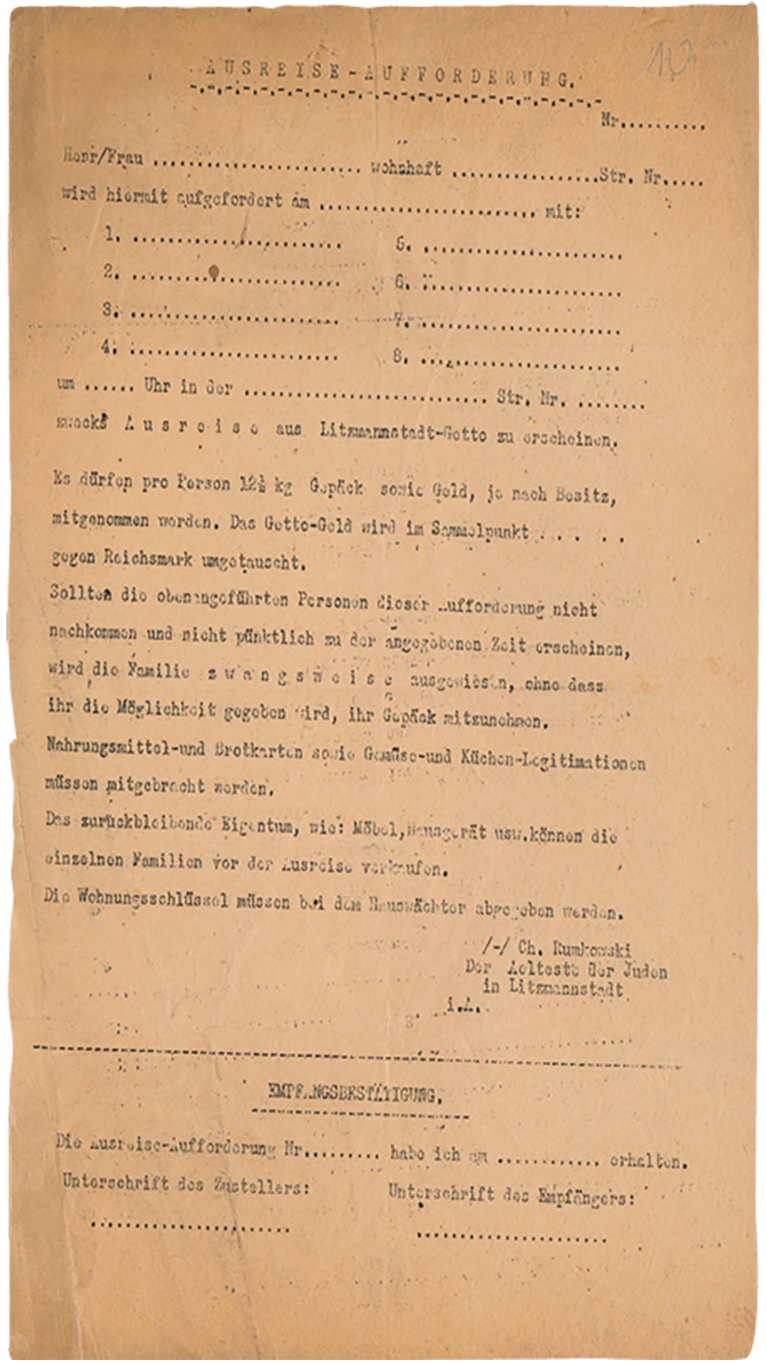
Deportation order, known as “wedding card” in the ghetto
(Archiwum Państwowe w Łodzi)
In January 1942, the first deportation began in the ghetto, the preparation of which, according to an order from the German authorities, fell to the Jewish administration. A special deportation order form was developed, which in the ghetto was called a "wedding card." The principle of non-separation of families was adopted, so the order included the person designated for departure (first those with convictions, then the unemployed) and family members. In many cases, persons living at the same address, although not members of the family, were designated. Each person was entitled to 12.5 kg of luggage. The designated average of three days to prepare for departure.
The deportation orders were delivered by postmen. One of them, Leon Merrick, (Laib Kuśmirek) recalled after years:
“We were delivering letters to report for the transports. So it was pitiful. Especially in the wintertime. I had a letter for somebody to report for a transport and I come to the certain building and I holler out a name like “Goldberg” or “Lichtenstein,” whatever his name might be. And then I’d hear a faint voice answering behind the curtains. The people that burned the doors, so they put blankets up in front of the door. Especially in wintertime, the blanket was all frozen stiff. So anyway, I heard a faint voice behind the blanket, I knew somebody was there inside. And I made my way in and I heard cracks in the curtain, the ice goes falling down. And eventually I come inside and I don’t have any good news for them, just to report for transports. And they’re all laying in the bed, it was pitiful. You know they’re hungry in bed." [source]